
A repository of sensitive user data, maintained by a centralized entity, that becomes an attractive target for malicious actors and cybercriminals. These do not exist in decentralized blockchain networks because users engage in self-directed peer-to-peer transactions and no third party collects user data.
Regulatory Compliance & Growth in the U.S.A & Abroad
DARA
Digital Asset Regulatory Authority
A Self Regulated Organization
Presented By:
DARA U.S & DARA International
Blockchain Legal Institute Foundation
Digital Asset & Tech News From Around The USA
- Follow DARA on LinkedIn for News Posts
- Word of the Month: Honey Pot
- Federal & State Updates
- Special Speaker: Sulaiman Javed, Strategic Board Advisor, DARA’s Consortium of Stablecoin Issuers & Senior Counsel Director Blockchain & Digital Assets @ MasterCard
- Next Steps

Information Honeypot
Word of the Month: Honeypot
Revolut recently reported an extortion attempt to leak users’ sensitive KYC data. Centralized compliance regimes turn user info into high-value honeypots.
Decentralized, privacy-preserving systems reduce risk instead of concentrating it. Here comes our word of the week: information honeypot.
Global News:
FATF Advances Global Oversight of Digital Assets with New Reports
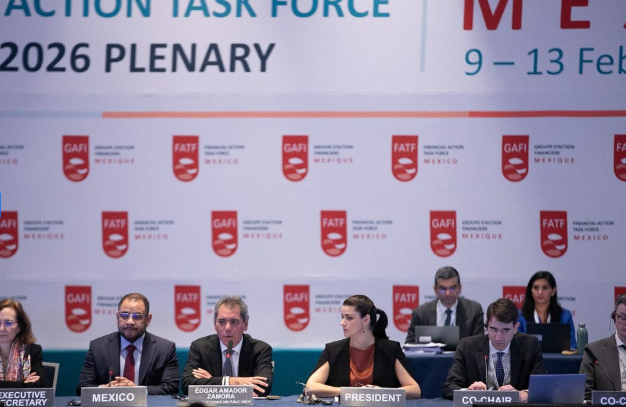
On February 13, 2026, the fifth Financial Action Task Force (FATF) Plenary meeting concluded and approved the creation of two new reports to address emerging risks and support responsible innovation in digital assets.
Global News - FATFA
On February 13, 2026, the fifth Financial Action Task Force (FATF) Plenary meeting concluded and approved the creation of two new reports to address emerging risks and support responsible innovation in digital assets.
- The first report, “Understanding and Mitigating the Risk of Offshore Virtual Asset Service Providers (oVASPs),” will cover risks associated with the unregulated provision of offshore VASP services, how gaps and differences in regulatory and supervisory coverage are exploited by criminals, and recommend actions for governments.
- The second report, “Targeted Report on Stablecoins and Unhosted Wallets,” will examine emerging risks associated with stablecoins and make recommendations to mitigate risks.
Global News - Markets In Crypto Assets (MICA)
According to a Reuters report, nearly one third of unlicensed crypto firms in France have yet to inform the Autorité des Marchés Financiers (AMF) whether or not they intend to acquire a license under the E.U.’s Markets in Crypto-Assets (MiCA) regulatory framework which requires that crypto firms receive a license to operate from national regulators in order to operate across the E.U. Stephane Pontoizeau, Executive Director of the market intermediaries and market infrastructures supervision directorate at the AMF, reportedly stated that the AMF reached out to firms in November 2025 to remind them that France’s transition period ends June 30, 2026. Of the approximately 90 crypto firms registered in France without a MiCA license, 30 percent have reportedly applied for a license, while 40 percent are not seeking a MiCA license. Firms which fail to comply with MiCA will be forced to cease operations in July 2026.
Congress
House Financial Services Committee Releases March Hearings Calendar
On February 19, 2026, the House Financial Services Committee (HFSC) announced its hearing schedule for March 2026, outlining the HFSC’s upcoming oversight and legislative priorities for the month.
- On March 5, the Financial Institutions Subcommittee will hold a hearing entitled “Fighting Fraud on the Front Lines: Challenges and Opportunities for Financial Institutions.”
- Also on March 5, the Capital Markets Subcommittee will hold another hearing entitled “The Role of Self-Regulatory Organizations in U.S. Markets: Examining FINRA and the MSRB.”
Ethereum Policy Advocacy Alliance Releases Paper “Securing Open Financial Infra for the Future”
On February 20, 2026, the Ethereum Policy Advocacy Alliance (EPAA) released a policy paper entitled “Securing Open Financial Infrastructure for the Future,” examining how open blockchain protocols are critical forms of financial infrastructure, comparable to the current foundational internet protocols that support modern digital services.
The paper highlights the need for adapting regulatory frameworks to help technologies flourish, and points out a challenge for policymakers: how to mitigate consumer and market risks while preserving the openness and neutrality that drive innovation and global infrastructure development.
Systems that are open-source, non-custodial, and peer-to-peer, where users interact directly and assets are not held or managed by a third party, present fundamentally different risk profiles from systems that custody assets or operate as intermediated financial services. They should be treated accordingly under law.
AI Updates
AI Agents Get Onchain Citizenship on Base
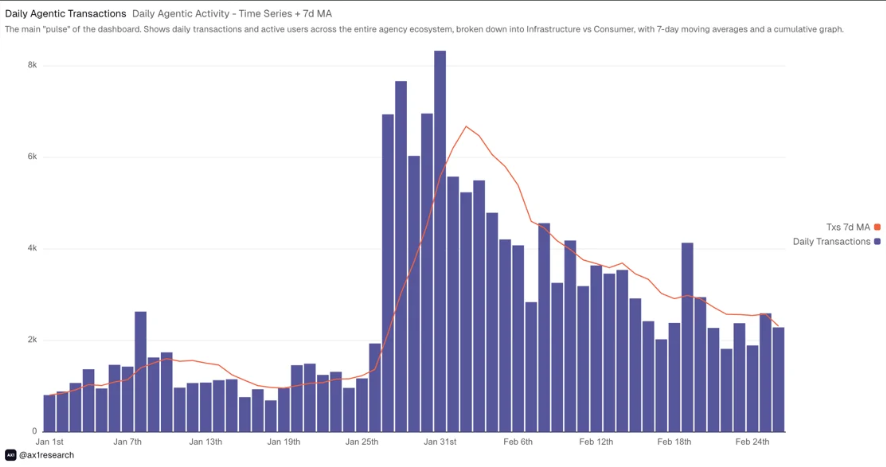
This week, the agent economy got another boost. Coinbase’s Agentic Wallets and the broader Base stack are enabling software agents to custody USDC, interact with DeFi, and transact autonomously at sub-cent fees. The footprint is already visible. Base’s ERC-8004 registry has surpassed ~21,000 registered agents. The ecosystem has processed ~462,000 agentic transactions YTD from ~99,000 unique addresses, with ~43,000 weekly transactions and ~13,000 weekly users. Over the last 30 days, agent-adjacent tokens on Base generated ~$260M in DEX volume from ~72,000 traders, capturing ~16% share versus Solana. Activity remains concentrated in early infrastructure leaders like Virtuals, which logged ~103,000 transactions and ~23,700 users over 30 days.
AI Agents
This is not just about better AI interfaces, but about software gaining native access to programmable dollars. As Circle CEO Jeremy Allaire noted on Feb 25, tens or hundreds of billions of agents could ultimately run on stablecoins, negotiating, allocating capital, and settling micropayments at fractions of a cent—flows that 2–3% card rails and batch wire systems cannot support profitably.
Citrini Research’s February 22 memo framed the stakes: agents routing payments over L2 stablecoins could erode interchange economics and pressure legacy networks. Once agents have wallets, payments become a software primitive. The institutions that build custody, controls, and policy engines around this new customer class will capture the flow; others risk disintermediation by default.
Electric Capital highlighted the legal frontier: when an autonomous agent overspends, is hacked, or causes damage, liability is unclear.
The next competitive layer will be identity, reputation, and compliance frameworks for non-human actors.
SEC - A Statement From EthDenver
Number Go Down and Other Schadenfreude
On February 18, 2026, during ETHDenver, SEC Chairman Paul Atkins and SEC Commissioner Hester Pierce discussed the agency’s evolving approach to digital assets.
During the exchange between Chair Atkins and Commissioner Pierce, Atkins explicitly stated that he would consider an innovation exemption or safe harbor for participants engaging with decentralized applications on public, permissionless blockchains. He emphasized that individual investors should have the freedom to choose between centralized intermediaries and decentralized applications for custody and trading.
“Under this possible approach, the innovation exemption would limit trading volume and could provide relief from some of our rules and certain other requirements that may not be relevant in light of how this technology works […] The exemption would be temporary but would last long enough for us to consider developing new rules and amending existing rules to allow such trading to continue under appropriate conditions in the future and to enable any parties that need to do so to register.”
Federal Updates
Promoting Innovation in Blockchain Development Act Introduced: Clarifying Criminal Code Section 1960 Liability
From the Defi Education Fund
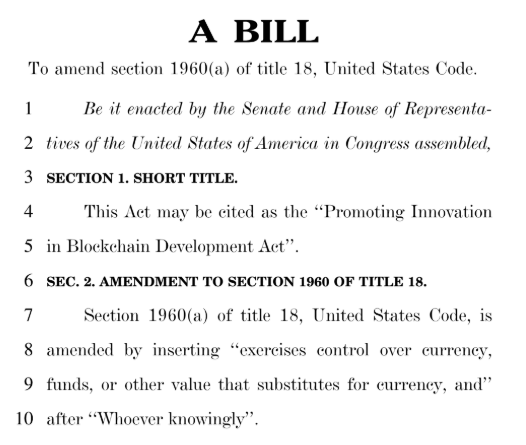
On February 26, 2026, Representatives Scott Fitzgerald (R-WI), Ben Cline (R-VA), and Zoe Lofgren (D-CA) introduced the bipartisan Promoting Innovation in Blockchain Development Act of 2026, legislation designed to protect software developers from inappropriate misclassification under criminal code Section 1960. The Promoting Innovation in Blockchain Development Act clarifies that Section 1960 applies only to those who control customer assets and transmit funds on their behalf, aligning the statute with congressional intent and the Treasury Department’s long-standing regulatory interpretation.
By clarifying the scope of who Section 1960 does and does not apply to, this bipartisan bill strengthens U.S. competitiveness in next generation digital infrastructure, while reinforcing national security. DEF is thankful to Representatives Scott Fitzgerald, Ben Cline, and Zoe Lofgren for their tremendous leadership in introducing this bipartisan bill and standing up for developers and American innovation. DEF urges members of Congress to support this bill, and we are happy to be a resource to any Congressional leaders looking to learn more.
Dune: A Research Tool - Global/States
A major European bank is now delivering regulated, programmable euro liquidity with native DeFi yield. In a USD-dominated market, EURCV shows how compliant non-USD stablecoins can capture a defensible niche: capital-efficient, composable, and institution-ready.
Société Générale’s SG Forge has built one of the clearest bridges between European TradFi and DeFi with EURCV, its fully MiCA-compliant, euro-pegged stablecoin backed 1:1 by high-quality reserves and live since late 2024. Since September 2025, EURCV (alongside USDCV) has been deployed natively into Morpho lending markets, where it can be lent against collateral ranging from tokenized money-market funds (EUTBL/USTBL via Spiko) to ETH and BTC.
On Feb 25, Safe integrated a Steakhouse-curated Morpho vault, enabling institutions and treasuries to earn euro yield directly within multisig workflows.
Euro-pegged stablecoins on EVMs, Solana, Tron and Stellar have now surpassed $960M in total supply, nearly doubling year-over-year. More broadly, non-USD stablecoins are expanding both as payment and remittance rails in regional corridors and as productive collateral within DeFi, particularly through Morpho vaults and euro-denominated assets.
State Updates
Arizona lawmakers held the inaugural meeting of the House Committee on Artificial Intelligence and Innovation on January 22, becoming the third state to create a committee directly aimed at the rapidly developing technology. The stated aim of the committee is to evaluate the technology and the legislature’s role – if any – in developing policy to regulate AI in Arizona.
Stablecoin Updates
Fidelity announced Fidelity Digital Dollar (FIDD), a $1-redeemable stablecoin launching on Ethereum. The product targets institutional and eligible retail users, and positions Fidelity to use stablecoins across its brokerage, wealth, and digital asset platforms.
It matters because:
- Captured balances and platform efficiency: tokenize Fidelity customer cash so dollars move 24/7 across Fidelity-controlled workflows.
- External liquidity: make FIDD widely accepted and liquid outside Fidelity.
- Walled garden advantage: Fidelity can use FIDD across brokerage, wealth, and institutional workflows where it controls distribution and integration.
- Institutional cash management wedge: custody, controls, reporting, and reserve management are Fidelity’s natural strengths.
- DeFi is not the first act: most Fidelity customers are not DeFi-native, and DeFi dollar liquidity remains largely USDC-native.
Tether Launches USA₮, A U.S. Regulated Stablecoin Via Anchorage
Tether announced USA₮ (USAT), a U.S.-market dollar stablecoin designed to operate under the GENIUS Act framework, with Anchorage Digital Bank, N.A. as issuer and Cantor Fitzgerald as reserve custodian. USAT began rolling out across major venues including Kraken, OKX, Crypto.com, and Bybit, with additional listings announced by Bitfinex and HTX.
Why it matters
Tether is effectively splitting its dollar strategy: offshore scale (USDT) plus an onshore, federally-aligned token (USAT)
- USDC is the target, distribution matters: USAT will compete directly with Circle/USDC in the US, but outcomes likely hinge on listings, banking rails, institutional onboarding, and liquidity depth more than token features.
Bridge secured OCC approval for a national trust charter.
Payoneer rolled out stablecoin capabilities to 2M businesses.
Anchorage launched compliant minting and settlement infrastructure for non-U.S. banks.
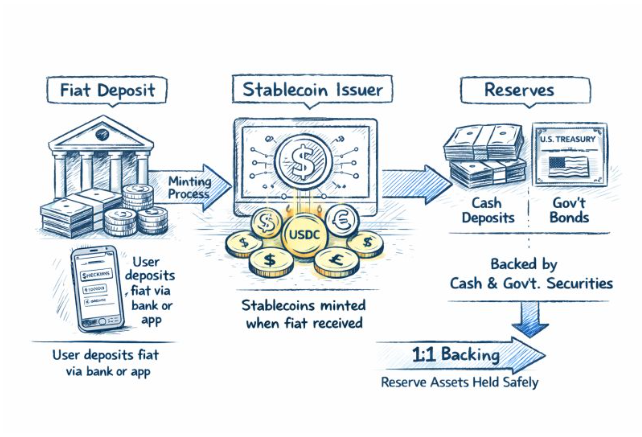
What do you need to know about Stablecoins?
Sulaiman Javed - Guest Speaker
Sulaiman Javed is a Senior Counsel specialising in digital assets, fintech and financial services. He currently serves as Global Senior Counsel for Digital Assets and Blockchain at Mastercard, where he advises on tokenisation, stablecoins, CBDCs, and blockchain-based payment solutions across multiple jurisdictions. His work sits at the intersection of product enablement, policy, and innovation, with a strong focus on responsible adoption of emerging technologies.
Sulaiman has extensive in-house experience spanning global financial institutions and high growth fintechs, including CMC Markets, Northview Group and a crypto start-up, where he has advised on regulatory compliance, product structuring, governance frameworks, and complex commercial arrangements. He holds an LLB, an LLM, and a distinction from the University of Oxford’s Blockchain Strategy Programme, and is a qualified solicitor in England and Wales
Additional Resources
Visit DARA.FOUNDATION
Visit BLI.TOOLS.
www.marylandblockchainassociation.org
Visit MARYLANDBLOCKCHAINASSOCIATION.ORG.